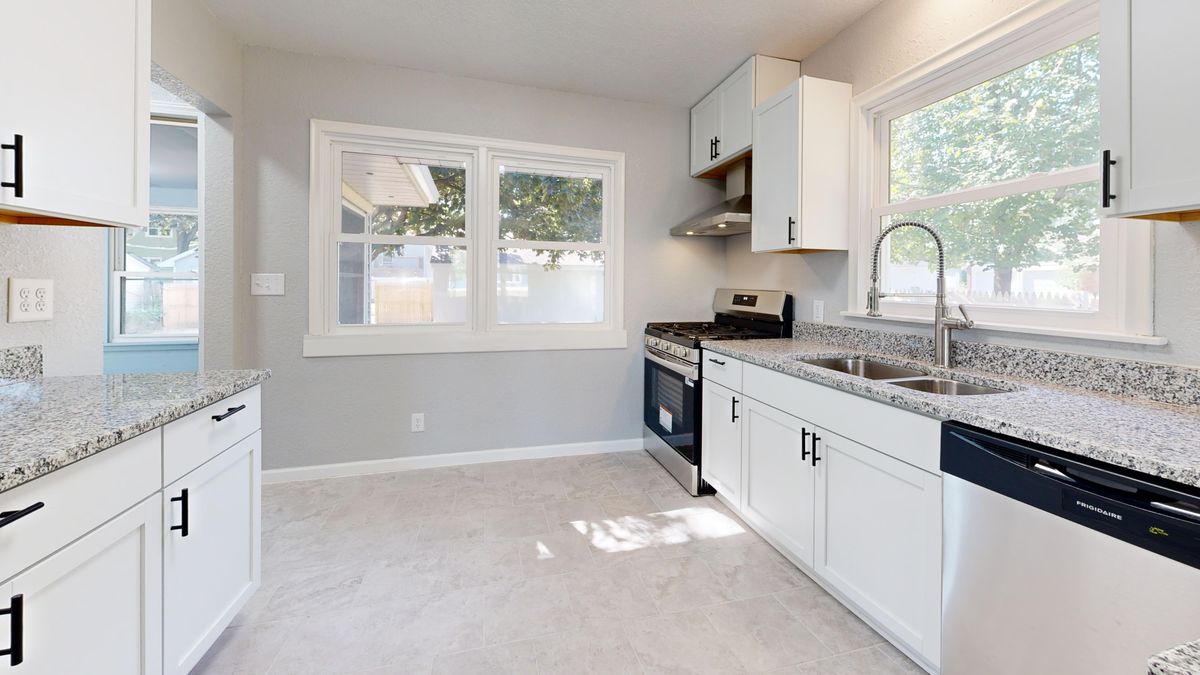
Countertops typically account for somewhere around 10-15% of a kitchen remodel budget, but the material you choose affects far more than that line item alone — it shapes daily maintenance, how the kitchen photographs and shows to future buyers, and how the whole room reads visually. Here's how the four most commonly compared materials actually stack up, starting with the question most people search first: laminate vs. granite countertops.
Laminate vs. granite: quick answer
Choose laminate if upfront cost is your top priority. It has the lowest cost of the four materials and needs no sealing, but it is more vulnerable to heat damage, scratches, and chipped seams or edges.
Choose granite if you want real natural stone. It sits at mid-range cost, is very hard and heat resistant, and needs periodic sealing to resist stains.
In short, laminate saves money up front, while granite trades a higher price and occasional sealing for durability and a natural-stone look.
| Material | Relative cost | Durability | Maintenance |
|---|---|---|---|
| Laminate | Lowest | Moderate — vulnerable to heat & scratches | Low — wipe clean, no sealing |
| Granite | Mid-range | High — very hard, heat resistant | Moderate — needs periodic sealing |
| Quartz | Mid to upper-mid | High — engineered, non-porous | Low — no sealing required |
| Marble | Highest | Lower — soft, porous, prone to etching | High — regular sealing, careful cleaning |
Laminate: the budget-friendly workhorse
Laminate has come a long way from the countertops of decades past. Modern high-pressure laminates can convincingly mimic stone or concrete patterns at a glance, install quickly, and require no sealing. The trade-offs: it's more vulnerable to heat damage (always use a trivet) and can scratch or chip at seams and edges over time, and it doesn't fully replicate the depth and texture of real stone up close. It's a smart choice for a budget-focused remodel, a rental property, or a kitchen you plan to update again down the line.
Granite: the enduring natural-stone classic
Granite has been a go-to natural stone for kitchen counters for decades because it's extremely hard, heat-resistant, and available in a wide range of natural patterns, with no two slabs identical. Being a natural, porous stone, it does need periodic sealing (typically every year or so, depending on the specific stone and sealant) to resist staining. For homeowners who want genuine natural stone at a somewhat lower cost than marble, with better everyday durability, granite remains a strong option.
Quartz: the engineered, low-maintenance favorite
Quartz countertops are engineered from ground natural quartz combined with resins, which makes them non-porous — no sealing needed — and highly resistant to scratching and staining, with far more consistent color and pattern than natural stone since it's manufactured rather than quarried. It has become one of the most popular choices for exactly this combination of low maintenance and high durability, and pricing is often competitive with or below higher-end granite and well below marble. The main trade-off versus natural stone is that quartz can be damaged by extreme, sustained heat, and some purists feel it lacks the organic variation of real stone.
Marble: the luxury choice, with real trade-offs
Marble's veining and soft, luminous look is hard to replicate, which is exactly why it remains the aspirational choice for many kitchens, especially in higher-end and luxury remodels. But it's genuinely the least practical of the four for hard daily use: it's softer than granite or quartz, porous enough to stain from wine, citrus, or oil if not sealed and cleaned promptly, and prone to etching (a dulled, cloudy mark) from acidic spills, even with sealing. Many homeowners who love the marble look choose it for an island or a lower-use surface, and pair it with a more durable material like quartz on primary work surfaces.
How to choose
- Tightest budget: laminate.
- Want real stone, don't mind occasional sealing: granite.
- Want low maintenance and high durability, budget allows mid-to-upper range: quartz.
- Want the marble look, willing to accept more upkeep: marble on an island or accent surface, paired with quartz or granite on primary work areas.
Choosing a top for a bathroom vanity? The same four materials apply, and our bathroom vanity cost calculator shows how each one changes the estimate.
Two more options worth knowing about
Laminate, granite, quartz, and marble cover the large majority of kitchen countertop installations, but two additional materials come up often enough to mention. Butcher block (solid wood) gives a warm, tactile surface that's popular on islands and in farmhouse-style kitchens; it can be sanded and refinished if it gets damaged, but it needs regular oiling, isn't naturally heat- or water-resistant, and can scar and stain more visibly than stone if left unsealed. Stainless steel is common in professional-style and minimalist kitchens for its extreme heat resistance and hygienic, non-porous surface, but it scratches and dents over time, shows fingerprints readily, and has a distinctly industrial look that isn't for everyone.
Edge profiles and other cost variables
The material itself is only part of the price. Edge profile (a simple eased edge vs. a decorative bullnose, ogee, or waterfall edge on an island) can add meaningfully to the cost of a stone or quartz countertop, since more elaborate profiles require more fabrication time. Sink cutouts, cooktop cutouts, seams (unavoidable on larger runs, and more visible on some patterns than others), and the overall square footage all factor into a final quote, which is why two kitchens with the "same" countertop material can end up with noticeably different final prices.
A quick note on sustainability
If environmental impact factors into your decision, it's worth knowing that natural stones (granite, marble) are quarried and require significant energy to cut and transport, while quartz is engineered using resins that are petroleum-based, and laminate is manufactured from paper and resin over particleboard. Butcher block, if sourced from a responsibly managed forest, is a renewable material, though it has the shortest realistic lifespan without refinishing of the options discussed here. There's no single "greenest" choice — the more sustainable option depends on which trade-offs (renewability, longevity, transport distance, end-of-life disposal) matter most to you.
Caring for what you choose
Whatever material you land on, a few habits extend its life regardless of type: use cutting boards rather than cutting directly on any surface, use trivets under hot cookware even on heat-resistant materials, wipe up acidic spills (wine, citrus, tomato) promptly on porous or soft materials like granite and especially marble, and follow the manufacturer's specific cleaning product recommendations rather than assuming any household cleaner is safe — some common cleaners can dull sealants or damage certain finishes over time.
See how countertop material changes your total
The kitchen remodel calculator adjusts your estimate based on laminate, granite, quartz, or marble.
Try the Kitchen Remodel CalculatorThere's no universally "correct" countertop material — the right choice depends on your budget, how hard your kitchen gets used day to day, and how much maintenance you're realistically willing to keep up with. Matching the material to your actual habits will serve you better long-term than matching it purely to a photo you liked. The same durability-versus-maintenance trade-off shows up underfoot, too — see our kitchen flooring comparison for how tile, hardwood, LVP, and laminate stack up.
It's also worth asking your fabricator directly about warranty coverage — many quartz manufacturers offer multi-year or even limited lifetime warranties against manufacturing defects, while natural stone typically carries a shorter or more limited warranty from the fabricator rather than the quarry, since natural variation isn't considered a defect. Understanding what is and isn't covered before installation avoids surprises if a seam, chip, or discoloration issue comes up later.
Bottom line
Think of countertop choice as a three-way trade between upfront cost, day-to-day durability, and ongoing maintenance — no material wins on all three at once. Laminate wins on upfront cost, quartz wins on the durability-to-maintenance ratio, granite splits the difference with natural character, and marble wins on looks alone at the price of real upkeep. Matching the material to how your household actually cooks and lives will hold up better over ten years than matching it purely to a photo you liked.