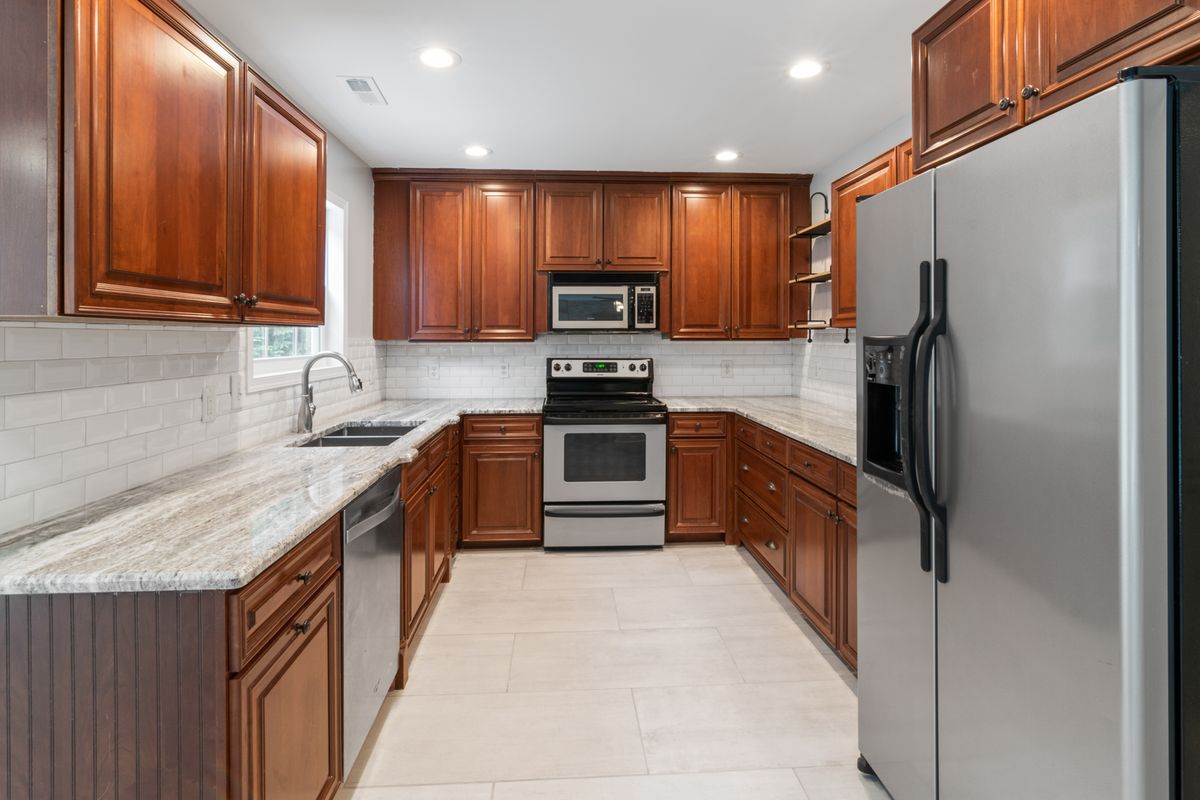
Cabinets are the single biggest line item in almost every kitchen remodel budget — commonly around a third of the total project cost. So the choice between stock, semi-custom, and custom cabinetry (and especially the semi-custom vs custom cabinets decision) is arguably the most consequential material decision you'll make. Here's what actually separates the three tiers, beyond just price.
The three tiers, in plain terms
Stock cabinets are pre-manufactured in a limited set of standard sizes and finishes, kept in warehouse inventory, and typically available for pickup or delivery within a week or two. Semi-custom cabinets start from a manufacturer's standard product line but allow modifications — extra width or height increments, additional finish and door-style options, specialized storage inserts — and are built to order. Custom cabinets are designed and built from scratch for your specific kitchen, with essentially no constraint on dimensions, materials, or configuration, usually by a local cabinetmaker or a high-end manufacturer.
| Tier | Typical lead time | Size flexibility | Best for |
|---|---|---|---|
| Stock | 1-2 weeks | Fixed standard sizes only | Tight budgets, simple layouts, rentals/flips |
| Semi-Custom | 4-8 weeks | Modified widths/heights, many finish options | Most kitchen remodels |
| Custom | 8-16+ weeks | Fully bespoke dimensions and materials | Unusual layouts, high-end finishes, statement pieces |
Stock cabinets: the budget-conscious choice
Stock cabinetry has improved substantially in recent years — you can get solid-wood doors and reasonably durable boxes at this tier now, not just the particleboard-and-laminate options of decades past. The trade-off is fit: if your kitchen has an unusual dimension, an awkward corner, or a specific appliance that needs an exact opening, stock sizing may leave gaps that need filler panels, which can look like an afterthought if not planned carefully.
Stock is a genuinely good option for straightforward, rectangular kitchen layouts, rental properties, and house flips where budget discipline matters more than a perfectly bespoke fit.
Semi-custom: where most remodels land
Semi-custom is the workhorse tier for a reason. You get meaningfully more flexibility than stock — extra depth options, additional height increments to reach a ceiling or accommodate a hood, dozens of finish and hardware combinations, and specialty inserts like pull-out trash bins, spice racks, or corner carousel systems — without stepping up to full custom pricing or custom lead times. For most homeowners doing a mid-range remodel, this is the tier that balances cost, selection, and turnaround time best.
Custom: when it's actually worth it
Custom cabinetry makes the most sense when your kitchen has a layout constraint that off-the-shelf sizing genuinely can't solve — an oddly-shaped island, a non-standard ceiling height, integrated furniture-style built-ins — or when you want a specific wood species, joinery detail, or finish that isn't available through semi-custom lines. It's also common in luxury remodels where the cabinetry itself is meant to be a design centerpiece.
The trade-off is real: expect meaningfully higher cost than semi-custom for the same square footage, and lead times that can stretch past three or four months, which needs to be built into your project timeline from day one.
Semi-custom vs custom cabinets: side by side
| Factor | Semi-custom | Custom |
|---|---|---|
| What it is | Starts from a manufacturer's standard line, with modifications, built to order | Designed and built from scratch for your kitchen, usually by a local cabinetmaker or a high-end manufacturer |
| Typical lead time | 4-8 weeks | 8-16+ weeks |
| Size flexibility | Modified widths and heights, many finish options | Fully bespoke dimensions and materials |
| Typical construction | Usually full plywood boxes, dovetail drawer joinery, and a wider selection of solid-wood door styles | Essentially any construction method you are willing to pay for, from solid hardwood to specialty finishes |
| Relative cost | A moderate increase over stock | Meaningfully higher than semi-custom for the same square footage |
| Best for | Most kitchen remodels | Unusual layouts, high-end finishes, statement pieces |
A practical way to decide
- Standard rectangular or L-shaped kitchen, budget-focused: stock, possibly with a semi-custom island.
- Typical remodel, want good finish options and specialty storage: semi-custom.
- Unusual layout, specific finish requirements, or a luxury-tier remodel: custom.
- Tight budget but want a custom look: semi-custom cabinets for most of the kitchen, with one custom or furniture-style piece (like an island or hutch) as a focal point.
The same three tiers apply to bathroom vanities. If you are pricing one, our bathroom vanity cost calculator shows how stock, semi-custom, and custom change the estimate.
If your existing boxes are sound, you may not need to buy new ones at all: our cabinet refacing cost calculator compares refacing with replacing at each tier. To see how the cabinet tier shapes a whole small-kitchen budget, read our 10x10 kitchen remodel cost guide.
Don't forget installation and hardware
Cabinet installation labor and hardware (knobs, pulls, soft-close hinges and slides) are often quoted separately from the boxes themselves, and can meaningfully affect your total. Soft-close hardware in particular is worth the small upcharge across almost any tier — it's one of those details you notice every single day.
Materials and construction: what changes between tiers
Beyond size flexibility, the three tiers typically differ in construction quality, though there's overlap and it's worth checking specifics rather than assuming. Stock cabinets commonly use a mix of solid wood face frames with plywood or engineered-wood (like MDF or particleboard) box construction, which is perfectly durable for normal kitchen use but generally uses thinner box material and simpler joinery than higher tiers. Semi-custom lines usually step up to full plywood boxes, dovetail drawer joinery, and a wider selection of solid-wood door styles. Custom cabinetmakers can offer essentially any construction method you're willing to pay for, from furniture-grade solid hardwood to specialty finishes like hand-applied glazes or reclaimed wood.
None of this means stock cabinets are poorly made — reputable stock lines from established manufacturers hold up well for typical residential use. But if you're comparing quotes across tiers, ask specifically about box material (plywood vs. particleboard), drawer construction (dovetail vs. stapled), and drawer slide quality (soft-close, full-extension, ball-bearing vs. basic roller), since these details affect longevity more than the finish color does.
Hidden costs to ask about at every tier
A cabinet quote's headline price doesn't always include everything. Before comparing bids, ask each supplier or contractor explicitly about:
- Modification and filler charges: stock and semi-custom lines often charge extra for non-standard widths, filler strips, or corner solutions.
- Delivery and staging fees: especially relevant for custom orders shipped from a distant workshop.
- Installation labor: sometimes bundled with the cabinet price, sometimes billed entirely separately by your contractor.
- Hardware: knobs, pulls, and soft-close mechanisms are frequently quoted as an add-on rather than included in the base cabinet price.
- Crown molding, toe kick, and end panels: finishing details that pull a cabinet run together visually, but aren't always included by default.
Asking for a single itemized quote that lists each of these separately — rather than one lump "cabinets" line — makes it far easier to compare bids from different suppliers apples to apples, and to spot where one quote is cutting a corner another one isn't.
Questions worth asking your cabinet supplier
- What's the box material — plywood, particleboard, or MDF — and what's the drawer box construction?
- What's the actual lead time right now, including any current supply-chain delays, not just the catalog estimate?
- What's included in the base price versus billed as an upgrade (soft-close, dovetail drawers, specific finishes)?
- What's the warranty on the boxes, the finish, and the hardware, and who honors it — the manufacturer or the installer?
- How are non-standard dimensions or filler pieces priced?
Estimate your cabinet budget by tier
Our calculator models stock, semi-custom, and custom pricing directly into your kitchen remodel estimate.
Try the Kitchen Remodel CalculatorWhichever tier you land on, get an itemized quote that separates the cabinet boxes, any modifications, hardware, and installation labor — it makes comparing bids from different suppliers or contractors far easier, and it's the best way to spot exactly where your money is going.
Bottom line
There's no universally "right" cabinet tier — there's only the tier that matches your kitchen's actual layout constraints, your finish priorities, and your budget. Most homeowners doing a standard remodel will find semi-custom hits that balance well; stock deserves a serious look if the layout is simple and the budget is tight; and custom earns its price tag when your kitchen genuinely needs a solution that off-the-shelf sizing can't provide. Whichever tier you choose, get every cost — boxes, modifications, hardware, delivery, and installation — itemized in writing before you commit.